Jean-Michel Basquiat: A SAMO© Reference + Resource + Remembrance
  • Home
  • The Radiant Child
  • SAMO© Bio
  • Gallery
    • Basquiat Paintings
    • Collaborations >
      • Bischofberger on Collaborations
  • Words
  • Home
  • The Radiant Child
  • SAMO© Bio
  • Gallery
    • Basquiat Paintings
    • Collaborations >
      • Bischofberger on Collaborations
  • Words
Picture
Picture

1960-1971

1960
Jean Michel Basquiat born December 22, in Brooklyn Hospital. His mother, Matilde, is an artistic woman born in Brooklyn to Puerto Rican parents. His father, Gerard, is a Haitian born accountant.

1967
By age six, Jean-Michel is fascinated by drawing, and want’s to be a cartoonist. His childhood drawing is encouraged by his mother, who takes him to New York art museums.

1968
Jean-Michel is hit by a car while playing in the street, resulting in a broken arm, internal injuries and removal of his spleen. During a month-long recuperation in hospital his mother gives him a copy of the book Grey’s Anatomy, which greatly influences his later work.

His parents divorce. Jean and his two sisters stay with his father.

1970
Matilde is committed to a mental institution when Jean is 10 or 11, and subsequently spends time in and out of institutions.

1971
In 1971 the tag “Taki 183” becomes ubiquitous throughout New York City, especially in the subway, jump starting the modern graffiti movement. By the mid 1970s whole car pieces turned many trains into moving graffiti murals. Jean noticed these works and they influenced his later use of graffiti to gain fame.

1974-1980

1974-5
Gerard Basquiat takes a posting to Mira Mar, Puerto Rico, and moves with his three children. Jean-Michel runs away for the first time, but is brought back. The family moves back to Brooklyn at the end of 1975.

1977
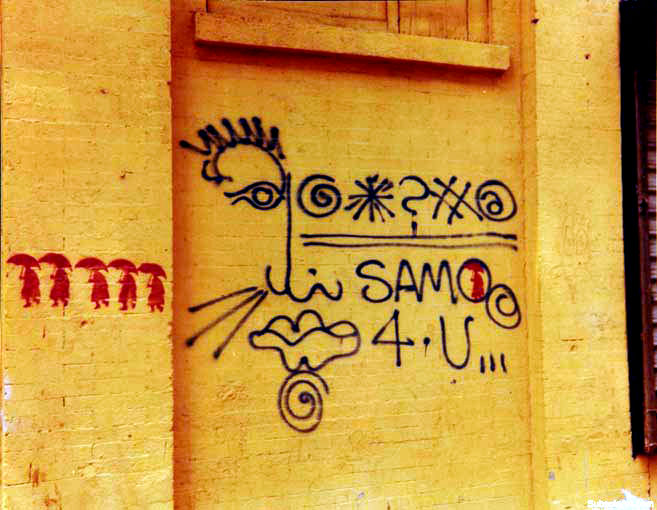
Jean-Michel Basquiat first develops “SAMO” comic character with friends at City As School high school.

1978
After throwing a cream pie in his principal’s face at a high school assembly, Jean-Michel runs out of school and never graduates.

In June he runs away from home for good, and spends time homeless and staying with friends in Manhattan.

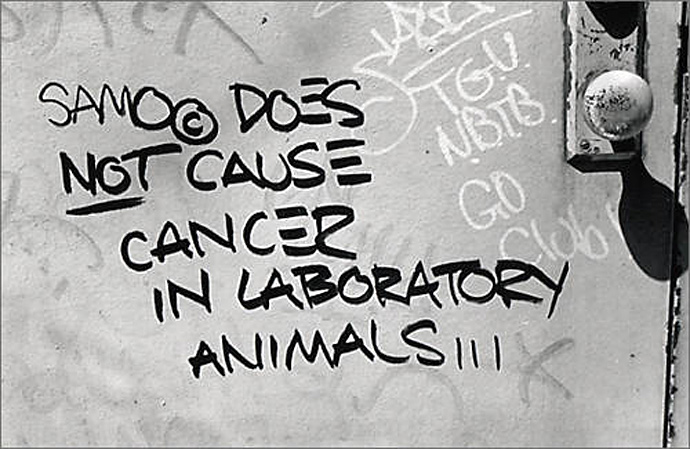
With friend Al Diaz, Basquiat paints many graffiti phrases in downtown Manhattan signed “SAMO.”

December 1978 Village Voice article on the SAMO graffiti interviews Basquiat and Diaz.

1979
First interviewed on Glenn O’Brien’s New York City cable TV talkshow “TV Party.” See the interview.

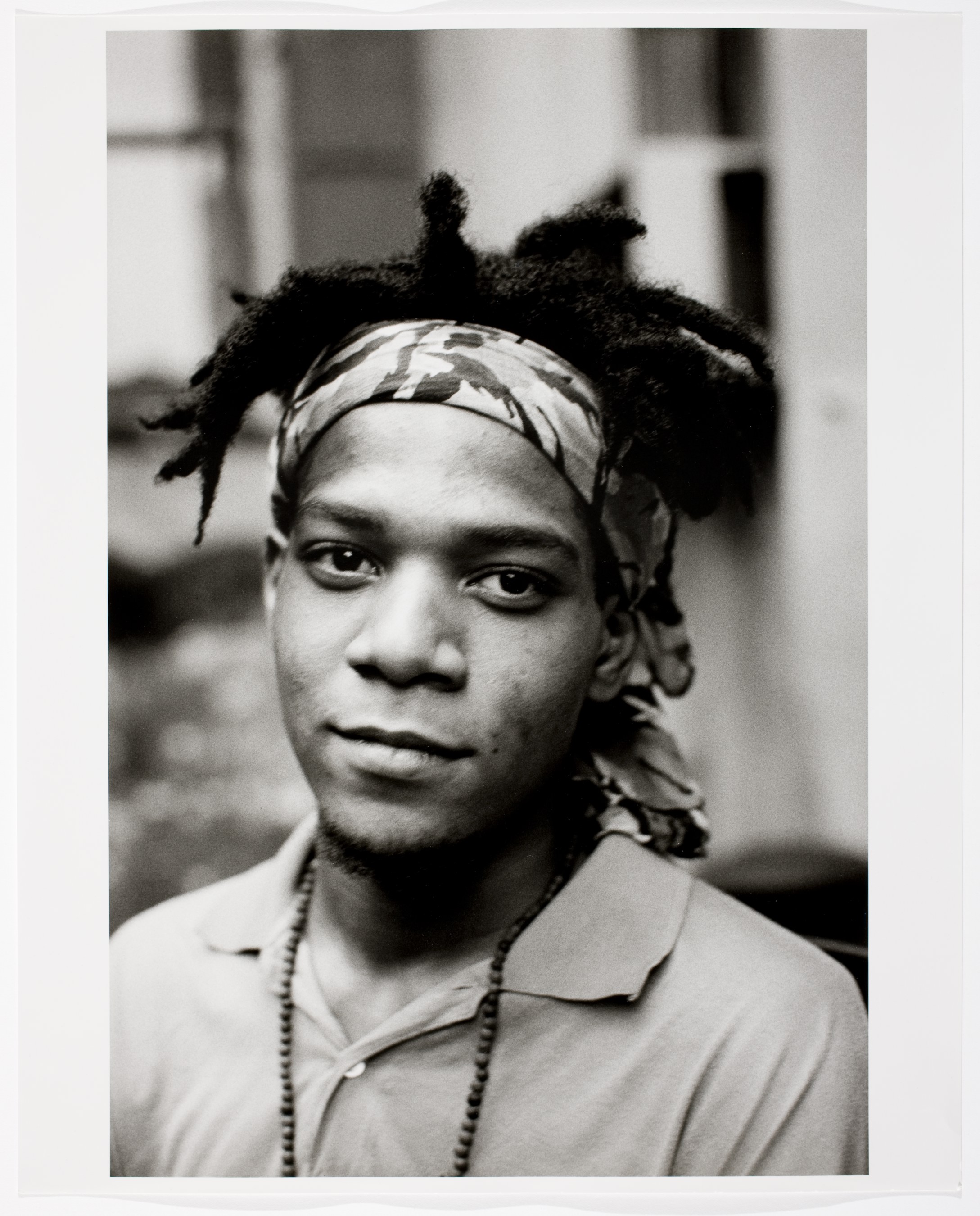
In May Basquiat helps found a short-lived noise band called ‘Gray.’ He is now well known on downtown scene. (Basquiat in 1979, Photograph by Nicholas Talyor)

Still without his own home, he befriends future artist Keith Haring, and other School of Visual Arts students.

1980
In June an abstract graffiti-like work in the alternative “Time Square Show” gives Basquiat his first one-line mention in the art press.

Basquiat is picked for the lead role of a down and out painter in New York Beat, a film showcasing New York’s downtown music scene. Filming starts in December 1980 and finishes January 1981 (released in 2001 as Downtown 81)

Basquiat moves in with Suzanne Mallouk, with whom he continues and on again off again affair for several years.​
Picture
Picture

1981-1985

1981
In January Republican Ronald Reagan becomes president of the United States. His presidency (1981-89), a period of mostly economic growth, increasing inequality, and the rise of the “Yuppie” culture, coincides with Basquiat’s career as a painter.

In February his sophisticated use of child-like images in “New York / New Wave” exhibition at the alternative P.S.1 (in Queens, NY) brings Basquiat to the attention of more adventuresome figures in the art world.

In September Basquiat invited by Annina Nosei to join her SoHo gallery, he soon has a studio in the gallery basement. In November Nosei’s Public Address group exhibition includes several large figurative paintings by Basquiat. 
​
December Artforum publishes Rene Ricard’s “The Radiant Child” article, which brings Basquiat to international attention.

1982
In March Basquiat’s 1st US solo exhibition, at Annina Nosei Gallery, gets rave reviews. From this point on he supports himself from the sale of his paintings.
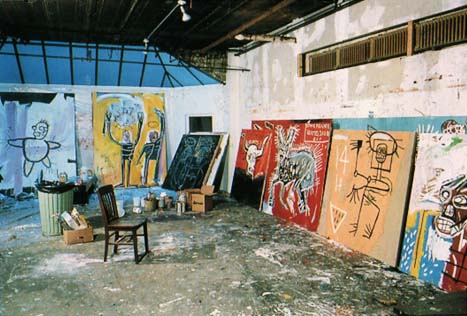
In the Fall of 1982 he is working at his new Crosby Street loft.  Develops a busy style mixing many words and images, often done on intentionally primitive handmade stretchers created by his new studio assistant Stephen Torton.

Basquiat is invited to Andy Warhol’s loft “the Factory” for the first time, and they do each others portraits. (Warhol portrait “Jean-Michel Basquiat,” 1982)

Basquiat’s November Fun Gallery exhibition in the East Village is a popular and critical success.
(See the November 1982 interview with Basquiat by Marc H. Miller for Paul Tschinkel’s 1983 Art New York video.)

1982-3
Basquiat has a brief relationship with Madonna, from fall of 1982 to early 1983. Stays in Los Angeles for the winter, where he has show at Gagosian gallery and produces Beat Bop album with Rammellzee.


1983
Basquiat is included in 1983 Biennial Exhibition at the Whitney Museum. In August rents a loft at Great Jones Street from Andy Warhol, where he lives and works.
September 15th death after police arrest and beating of graffiti writer Michael Stewart. Basquiat commemorates the event in the painting “Defacement.”

1984
Joins the Mary Boone Gallery in March, and has his first show there in May. The crowded show of smaller paintings gets mixed reviews, but is a commercial success.

In May his paintings are included in the Museum of Modern Art’s re-opening exhibition, “International Survey of Painting and Sculpture.” In August he has his first solo museum show in Edinburgh, and two works are included in “Since the Harlem Renaissance: 50 Years of Afro-American Art” in Pennsylvania.

In the Fall Basquiat begins a love affair with Jennifer Goode, an employee of the Area nightclub
The September exhibition “Collaborations: Basquiat ,Clemente, Warhol” shows 15 collaborative works at the Bruno Bischofberger gallery in Zurich.
1984-5: From Fall of 1984 to Summer of 1985 Basquiat spends several days a week working on collaborative works with Andy Warhol in Warhol’s “factory” studio. The two often go out at night together as well.

1985
February 10th Basquiat appears on the cover of The New York Times Magazine.  The article introduces him to a new audience, but also becomes a often cited example of hype in the art world. (Photograph, copyright Lizzie Himmel, 1985) (Article, by Cathleen McGuigan)

Second exhibition at Mary Boone gallery in March. The varied work includes the striking Gold Griot painted on wood boards. The catalog essay by Robert Farris Thompson mentions ‘black vision’ ‘blues typography’ and ‘kreyol’ aspects to his work.
Henry Geldzahler arranges for Basquiat to paint a mural in newly opened Palladium nightclub.
The September Warhol-Basquiat collaborative show at Tony Shafrazi gallery is panned by critics. (Basquiat and Warhol at gallery, photo Tseng Kwong Chi)

Basquiat breaks off his close relationship with Warhol. Friends worry about his drug use.


1986-1992

1986-1992

1986
Trip to Ivory Coast, Africa, with Jennifer Goode and Bischofberger for an exhibition (10/10/86 – 11/07/86) in Abidjan (Basquiat at Exhibition).
Final break with Mary Boone gallery on return from Africa.

Joins drug rehab program, but leaves after few weeks. End of relationship with Jennifer Goode. (Basquiat, 1986, Photograph by William Coupon)

1987
On February 22, Andy Warhol dies unexpectedly after undergoing a routine gallbladder operation. Basquiat is devastated and depressed. His drug use increases, and he spends more time alone in the studio. (Jean-Michel Basquiat, 1987 photograph by Ari Marcopoulos)
​

Paints the obsessively detailed black and white Pegasus while morning for Warhol, and the Warhol memorial construction Gravestone.
Photo of Basquiat at Whitney Museum opening of Julian Schnabel retrospective, with friend Keith Haring, 1987.

1988
April  29 – June 11 Exhibition at Baghoomian Gallery (his first New York show of paintings in over two years) is a success, and seen as a comeback.
June, Travels to Hawaii in an attempt to kick his drug habit on his own.
​

August 12th, Jean-Michel Basquiat dies from “acute mixed drug intoxication” in his Great Jones Street loft.

1992
Posthumous Basquiat retrospective exhibition at Whitney Museum, New York. Reviews of the exhibition, and especially the museum catalog, further the serious study of the artist.
Picture
Picture
Powered by Create your own unique website with customizable templates.